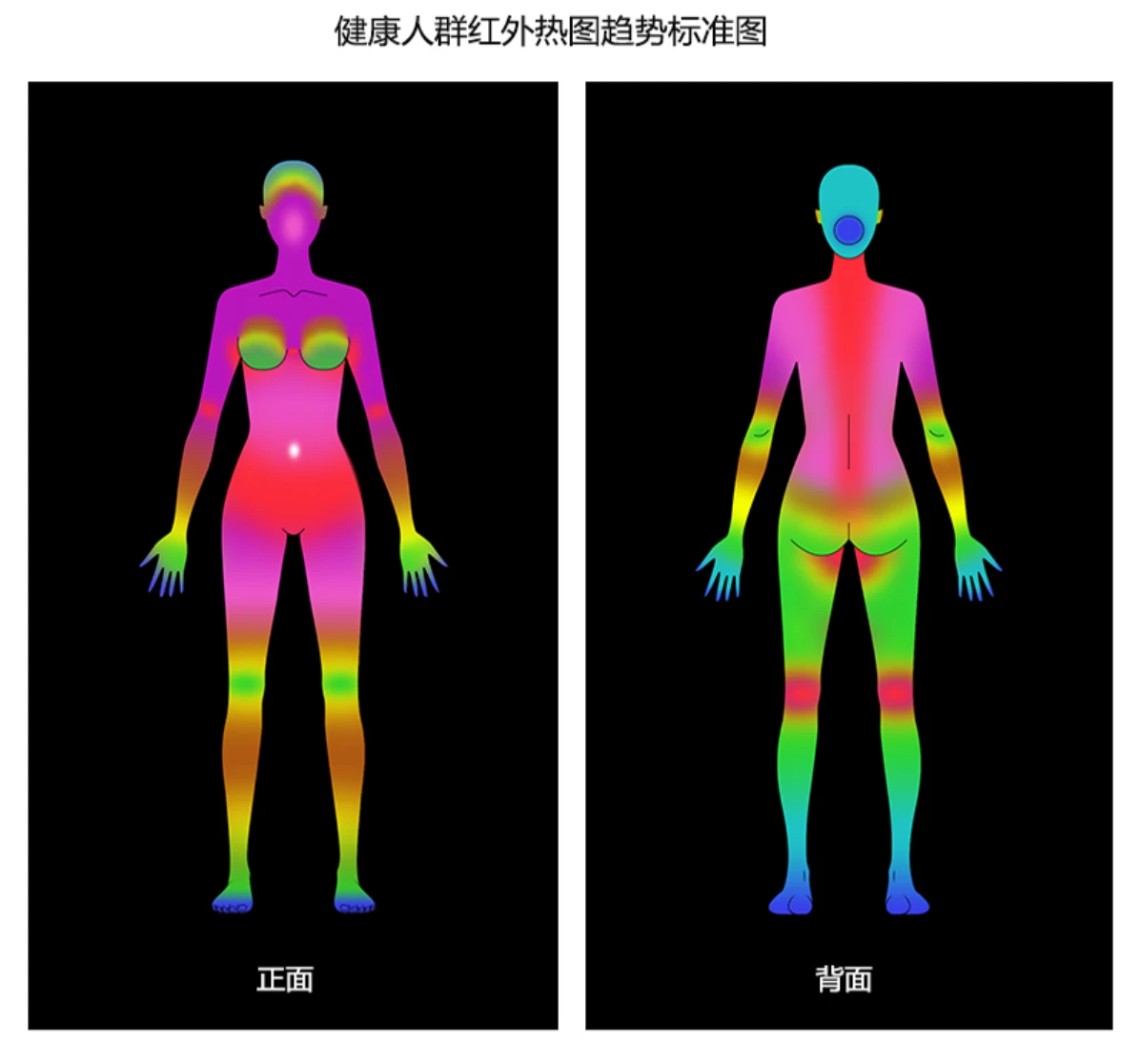
Pseudocolour
Colours represent mapped temperature values, not the natural colour of skin.
 煊土科技有限公司Sunterra Tech Limited
LINGSHU OS · ASSESSMENT METHOD
An infrared camera passively receives thermal radiation from the body surface and converts it into a temperature image. Pseudocolour makes spatial temperature differences easier to see.
The human body continuously emits and absorbs infrared radiation. Disease or functional changes in a region can alter local blood flow and temperature distribution, appearing as areas of higher or lower temperature. A thermal imaging system captures infrared radiation from the body and converts it into digital signals to generate a pseudocolour thermal image. Further analysis produces an infrared report, providing a visual basis for health data.
Prepare the camera and acquisition environment
Capture the required body views using the operating procedure
Convert the signals into a pseudocolour thermal image
Review location, distribution and relative temperature differences
Colours represent mapped temperature values, not the natural colour of skin.
Blue/black indicates lower and red/white higher regions. Palettes and ranges may differ; always read the image scale.
Review the shape, location and temperature difference together. A coloured region alone does not identify a disease.